
Ramp.
A new engineer makes a useful change in days, because the design can be read from the source.
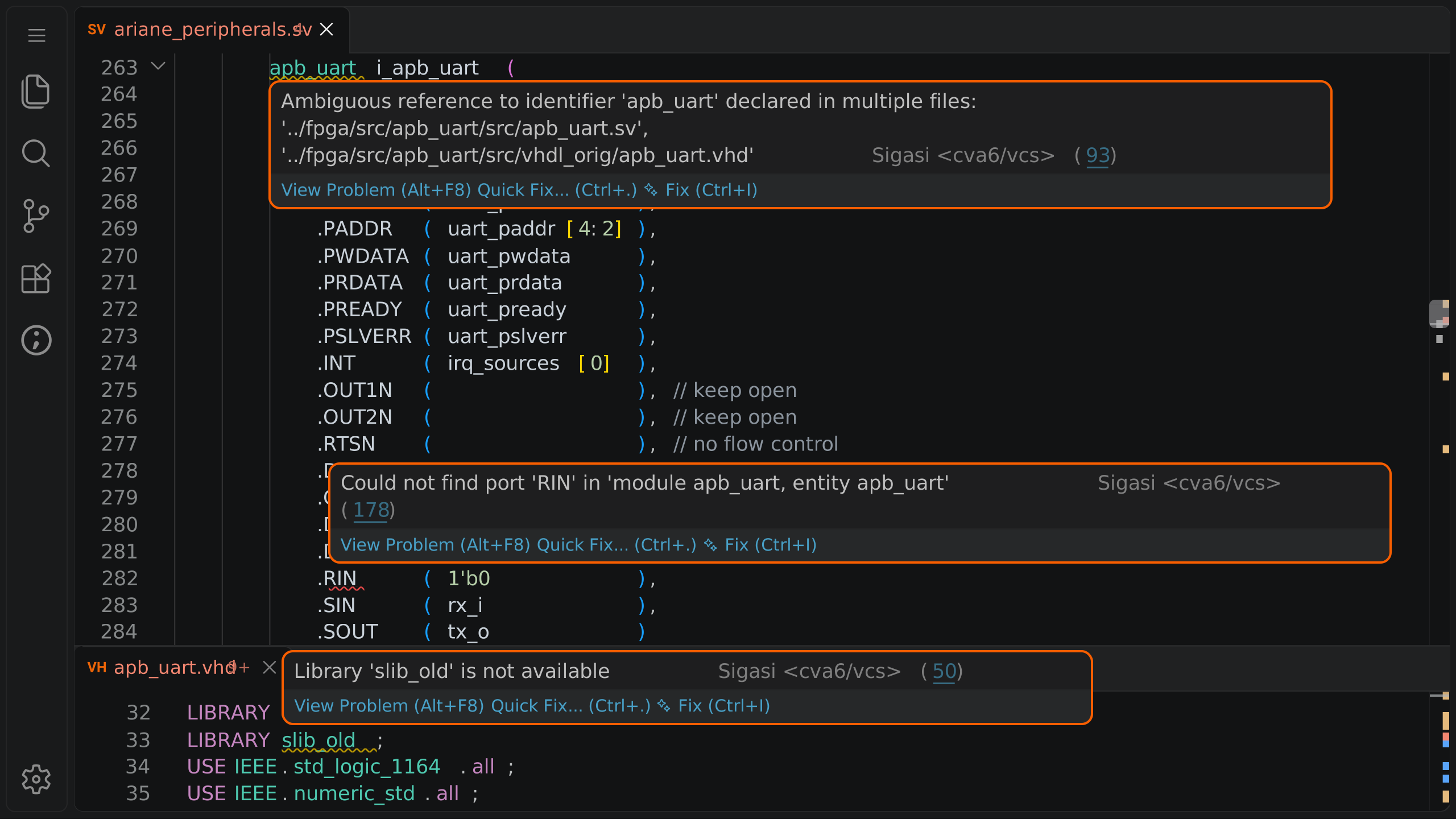
Your teams can already produce more RTL than they can review, and review is what sets the date. Sigasi settles what the project itself can answer, before it reaches a reviewer: declarations, libraries, dependencies, interfaces and rules, across SystemVerilog, Verilog, VHDL and mixed-language projects. Measurable on one project in three weeks, on your own infrastructure.
SystemVerilog · Verilog · VHDL · Mixed-language · Model-neutral and toolchain-independent · Analyzed locally, on your own infrastructure
A new engineer makes a useful change in days, because the design can be read from the source.

Reviewers spend their time on intent and trade-offs instead of on what the project already knows.

Issues surface in the week they are written, not at integration where they cost the most.

One configurable rule set, the same diagnostics in the editor and in CI, in every team and every site.

Not tied to one coding agent, one vendor, one simulator or one EDA suite.
Your engineers can already produce more RTL than your organization can review. Adding capacity on the generation side, headcount or agents, does not move the delivery date much, because the serial part of the work is what decides it.
The lever that does move it is reducing how much has to reach a reviewer at all.
Not skill, and usually not effort. It is the time spent establishing what is already true about the project: where a type is declared, which library a unit resolves to, what a change touched, and what an unfamiliar block does.
That time does not appear on any status report. It is most of the gap between a team that feels fast and one that does not.
| Change | Mechanism | What you would see |
|---|---|---|
| Faster ramp | Hierarchy, dependencies and diagrams generated from the source, always current | A new engineer making a useful change in days rather than weeks |
| Higher review throughput | Deterministic checks settle what the project itself can answer | Reviewers spending their time on intent and trade-offs |
| Fewer late surprises | Issues surface in the week they are written, not at integration | Less work in the expensive part of the program |
| Consistency across teams and sites | One configurable rule set, the same diagnostics in the editor and in CI | The same standard applied in every location, without a campaign |
| Less dependence on individuals | Documentation and views produced from the design | A block handed over without the person who wrote it |
Agents raise the volume of proposed change. They do not raise your review capacity, which is why more of them stops helping quickly.
Sigasi gives the agent the real project through MCP and the command line, and checks what it proposes with the same engine your engineers use. The agent is not grading its own work, and your engineers approve what moves downstream. Sigasi does not generate RTL and it does not decide.
This also keeps the tooling decision separate from the AI decision. One program may approve a cloud agent, another an internally hosted model, another none at all, and the same layer serves all three.
Not tied to one coding agent, one FPGA vendor, one simulator, or one vertically integrated EDA suite. Your AI strategy will change; this does not have to change with it.
It does not generate RTL, replace simulation, formal verification, synthesis or sign-off, or certify a design. It does not catch every issue. It runs the checks it documents, over the scope it is given, and it keeps your engineers accountable for what ships.
Pick one active project and measure against your own baseline rather than anyone’s claim:
If those numbers do not move, you will know inside one project. Request a team trial, or book a session on your own toolchain.
Compile at coding speed, so problems surface in the second they are written rather than at integration.
Fewer iterations, less wasted AI tokens, less review late in a program when work is most expensive.
RTL checked against your real project whether you or an AI agent wrote the code. You decide what moves forward based on facts, not hope.
12 weeks
16 weeks
10 weeks
6 weeks (-50%)
12 weeks (-25%)
10 weeks (no impact)
AI speeds up generation. Sigasi speeds up convergence. Evaluate it in a two to three week team trial on one active ASIC or FPGA project, on your own infrastructure, and measure the result with your own numbers.