Verification is eating the schedule
Done doesn’t mean “correct”
If you’re managing chip projects, the hardest part isn’t writing/generating more RTL; it’s predicting verification + debug. This isn’t an “FPGA problem” or an “ASIC problem.” It’s a verification predictability problem.
What the Wilson Research findings reveal
The 2024 Wilson Research Group functional verification trend reports paint a pretty blunt picture: design complexity is rising faster than verification capacity, and the industry is paying for it in escapes, respins, and delays.
1. Bug escapes are the norm in FPGA
The FPGA report asks a direct question: how many non-trivial bugs escaped into production? The headline is sobering: 87% of FPGA projects reported at least one non-trivial bug escape (meaning only 13% reported zero).
Source: 2024 Wilson Research Group FPGA Functional Verification Trend Report
In regulated markets (aerospace, safety, security), an escape isn’t “just a patch.” It can trigger revalidation, operational delays, and a whole new round of paperwork and testing.
2. First-silicon success in IC/ASIC is at a two-decade low
The IC/ASIC report uses the classic effectiveness metric: spins to production. The headline: only 14% of IC/ASIC projects achieved first-silicon success, the lowest level reported in two decades.
Different markets, different metrics — same message: teams are struggling to keep pace.
Source: 2024 Wilson Research Group IC/ASIC Functional Verification Trend Report
Schedules are slipping because verification work is expanding; and hard to predict
The reports also point to schedule pressure becoming the baseline expectation (not the exception), driven by the continuous loop between verification and debug.
And here’s the kicker for managers: debugging is not a nicely estimable activity — it’s highly variable, so project planning starts to feel like roulette.
The real villain: complexity growth across everything
Both reports highlight similar complexity drivers:
SoC-class design is normal now
Embedded processors are everywhere, which expands verification from “RTL behavior” to system behavior: HW/SW interaction, coherency, interconnect, and emergent corner cases.
Asynchronous clocks are everywhere
Multiple asynchronous clock domains are now common — and entire classes of issues (CDC/metastability behavior, reconvergence) don’t conveniently show up in “just RTL sim.”
Security & safety aren’t optional
Security features and safety guidelines add requirements, traceability, and compliance work. That increases verification volume and increases the cost of missing anything.
Verification maturity is rising… but the bottleneck isn’t gone
The industry is adopting more mature approaches (methodologies, formal techniques), but the overall outcomes are still moving in the wrong direction: escapes remain common and first-silicon success is low.
So: more sophistication, more tooling, more AI,… and still too much time spent in debug.
Where do you attack this?
You don’t “solve debugging.” But you can reduce the number of bugs that ever make it to debug — especially the ones that never should have existed.
Sigasi Visual HDL: your upstream RTL quality gate
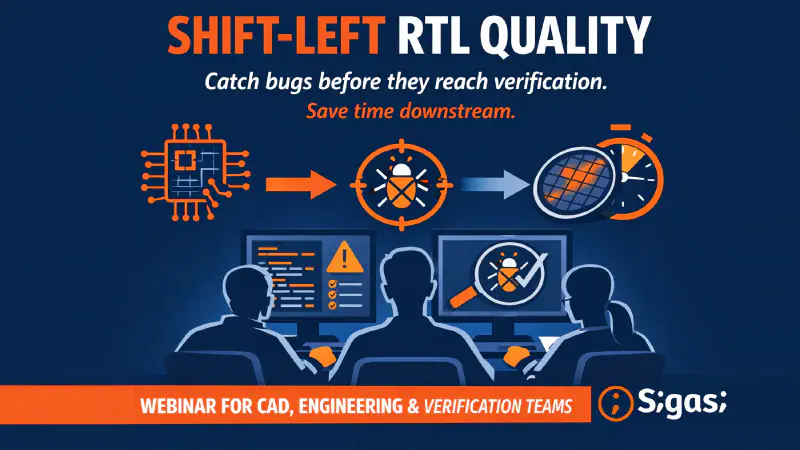
Sigasi Visual HDL is built to shift-left RTL quality by catching issues while design engineers are writing code, reusing IP, or integrating AI-generated code; before those defects become simulation churn or lab surprises.
A key point (and a deliberate guardrail): core diagnostics are deterministic and reproducible. That means you can rely on them in both the editor and CI without turning your flow into a noisy slot machine. The goal is fewer, higher-confidence findings; not more warnings.
What changes in practice
- Catch easy-to-fix defects early, when context is fresh and changes are cheap.
- Reduce noise in the verification pipeline, so verification engineers spend more time on hard bugs and corner cases.
- Reduce schedule risk by preventing avoidable issues from turning into late-stage slips or production escapes.
A practical way to validate ROI
Request a free trial license, run a short pilot on a real repo and track:
- issues caught pre-simulation
- reduction in PR review churn (comments/rework loops/time-to-merge)
- fewer “integration bring-up” surprises
We have seen customers compress schedules dramatically but without context it’s a blanket claim so we prefer you to experience the win yourself.
Let’s smash those bugs together
Our support engineers — hands-on, with extensive FPGA and ASIC design and verification experience — are happy to show how “shift-left” is done in our Sigasi Verification Frameworks webinar which is available on demand as it was broadcasted on on Wednesday, 28th of January. Watch it now.
2026-01-19, last modified on 2026-02-11